
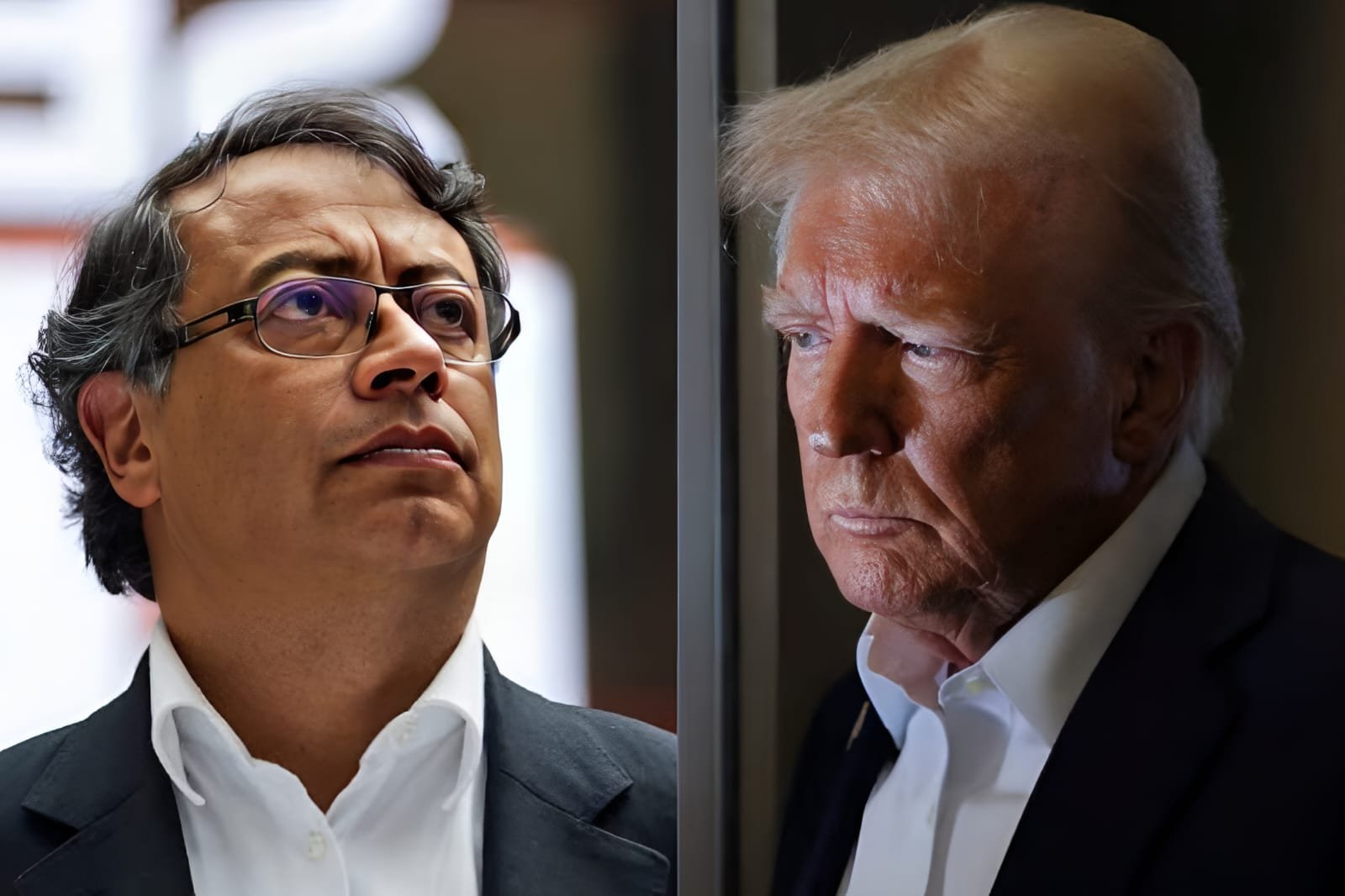
A DIPLOMATIC CRISIS THAT SHAKES WASHINGTON AND BOGOTÁ
The political world was shaken this Sunday after U.S. President Donald Trump launched a direct attack on Colombian President Gustavo Petro, labeling him an “illegal drug leader” and accusing him of doing nothing to stop cocaine production in the country.
The announcement was accompanied by an immediate decision: the United States will suspend all financial aid and subsidies to Colombia, effectively ending decades of bilateral cooperation on security and anti-drug operations.
Trump’s statements, published on his own social media platform, came with his usual tone — capital letters, threats, and a message that set off alarms across Latin America.
The words mark a before-and-after in U.S.–Colombian relations, historically close allies in the fight against narcotrafficking.
TRUMP’S HARSH WORDS
In his statement, Trump didn’t hold back. He said, verbatim:
“President Gustavo Petro of Colombia is an illegal drug leader who strongly encourages the massive production of narcotics in large and small fields all over the country.”
He added that drug trafficking has become “by far the biggest business in Colombia,” accusing Petro of doing nothing despite receiving “large-scale payments and subsidies from the United States.”
Then came the decisive part:
“As of today, these payments, or any other form of subsidies, will no longer be made to Colombia.”
Finally, Trump issued a direct warning that many analysts saw as a thinly veiled threat of intervention:
“Petro, a low-rated and very unpopular leader, with a fresh mouth toward America, better close up those killing fields, or the United States will close them up for him — and it won’t be done nicely.”
The phrases “killing fields” and “close them up for him” ignited a storm of reactions around the world, suggesting the possibility of U.S. unilateral action inside Colombian territory.
GUSTAVO PETRO’S RESPONSE
President Petro responded firmly and quickly through social media and official statements, rejecting Trump’s accusations and defending his administration’s peace-based approach to drug policy.
“Trying to promote peace in Colombia is not being a drug trafficker,” Petro wrote.
He also accused the United States of violating Colombia’s sovereignty after U.S. naval operations in the Caribbean allegedly killed Colombian citizens.
“Officials of the U.S. government have committed murder and violated our sovereignty in territorial waters,” Petro denounced.
Later, he clarified that his dispute was not with the American people but with Trump personally:
“I respect the history, culture, and people of the United States. They are not my enemies, nor do I feel them as such. The problem is with Trump, not with the United States.”
His words reveal a diplomatic strategy aimed at maintaining the alliance with Washington while condemning what he perceives as Trump’s arrogance and interference.
A RADICAL TURN IN A HISTORIC ALLIANCE
For more than three decades, Colombia has been one of the main U.S. allies in Latin America.
From Plan Colombia to bilateral security programs, Washington has invested billions of dollars to support coca eradication, counter-narcotics operations, and rural development.
Trump’s statements mark a sharp break from that tradition.
By calling Petro an “illegal drug leader” and cutting off financial aid, the U.S. sends a message of distrust and hostility, jeopardizing agreements, joint missions, and years of cooperation.
WHAT’S BEHIND THIS ESCALATION?
International analysts argue that Trump’s comments serve both domestic political purposes and his broader ideological war against Latin American left-wing leaders.
In recent weeks, he has intensified his rhetoric against what he calls “drug-tolerant regimes,” referring to Colombia, Mexico, and even sectors of Venezuela.
The conflict escalated after a recent U.S. military operation in the Caribbean destroyed a vessel allegedly involved in drug trafficking — a ship that, according to Colombia, was civilian and carried its national flag.
The incident triggered a formal protest from Bogotá and the temporary suspension of joint anti-drug meetings.
POSSIBLE CONSEQUENCES FOR COLOMBIA
The suspension of U.S. aid could have immediate repercussions:
- Security and defense: Most coca eradication programs depend heavily on U.S. funding, equipment, and intelligence.
- Economy: U.S. development aid supports rural transition projects; without it, thousands of jobs could vanish.
- Diplomacy: Trump’s accusation could isolate Colombia internationally and damage its credibility with Western allies.
- Legal implications: If Washington formalizes the charge, it would set a precedent for politically motivated criminal labeling of foreign leaders.
REGIONAL REACTIONS AND WASHINGTON’S SILENCE
Several Latin American governments expressed alarm at Trump’s tone.
Officials from Brazil and Mexico called the statement “a threat to regional sovereignty.”
Meanwhile, neither the White House nor the State Department has issued an official clarification, raising questions about whether this is an official U.S. policy change or a unilateral presidential order.
PETRO’S NEXT MOVES
In a national address, Petro announced that Colombia will present the case before the United Nations (UN) and the Organization of American States (OAS), arguing that Trump’s threats represent “a violation of international law and the sovereignty of nations.”
He reaffirmed that his government will continue combating narcotrafficking but “through peace and social justice, not war or foreign intervention.”
CONCLUSION: A CONFRONTATION THAT COULD REDEFINE THE AMERICAS
Donald Trump’s decision to label Petro an “illegal drug leader,” coupled with the immediate end of U.S. financial aid to Colombia, has triggered one of the most serious diplomatic crises in recent years.
Petro’s counter-response — denouncing the violation of Colombia’s sovereignty while appealing to dialogue — shows the deep ideological divide between the two presidents.
Beyond the personal feud, this clash exposes the fragility of international cooperation when politics, sovereignty, and security collide.
Whether it remains a war of words or becomes a full-blown geopolitical confrontation will determine the future of U.S.–Latin American relations in the coming months.